 Paint Match & Mix
The physics of physical paint, solved on a mobile device.
Digital color blending is fundamentally flawed. When digital screens blend red, green, and blue light (additive RGB), or when graphics software averages hex codes, they compute mathematical midpoints that have zero correlation with real-world physical pigments. Blue and yellow light blend into neutral gray; physical cobalt blue and cadmium yellow paint blend into vibrant emerald green.
For centuries, fine artists, miniature painters, scale modelers, and restorers have relied on intuition and wasteful trial-and-error to mix target colors. Industrial paint manufacturers use expensive benchtop spectrophotometers and proprietary formulation computers costing tens of thousands of dollars.
Paint Match & Mix brings rigorous Kubelka-Munk turbid-medium spectral physics into an offline-first mobile application. By combining real-time camera computer vision, non-linear absorption and scattering matrices, and constrained quadratic optimization, the application calculates exact physical paint drop ratios with sub-1.0 ΔE perceptual accuracy.
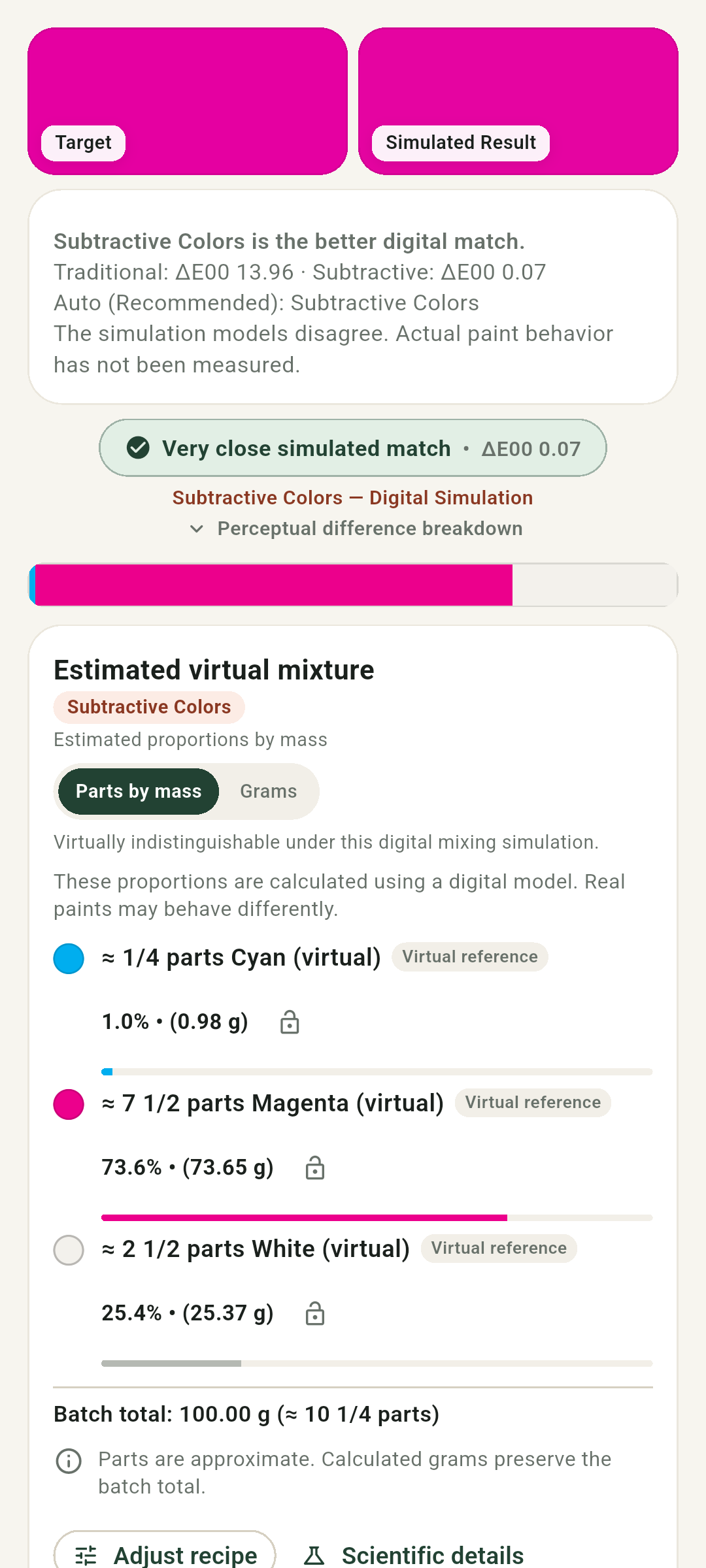
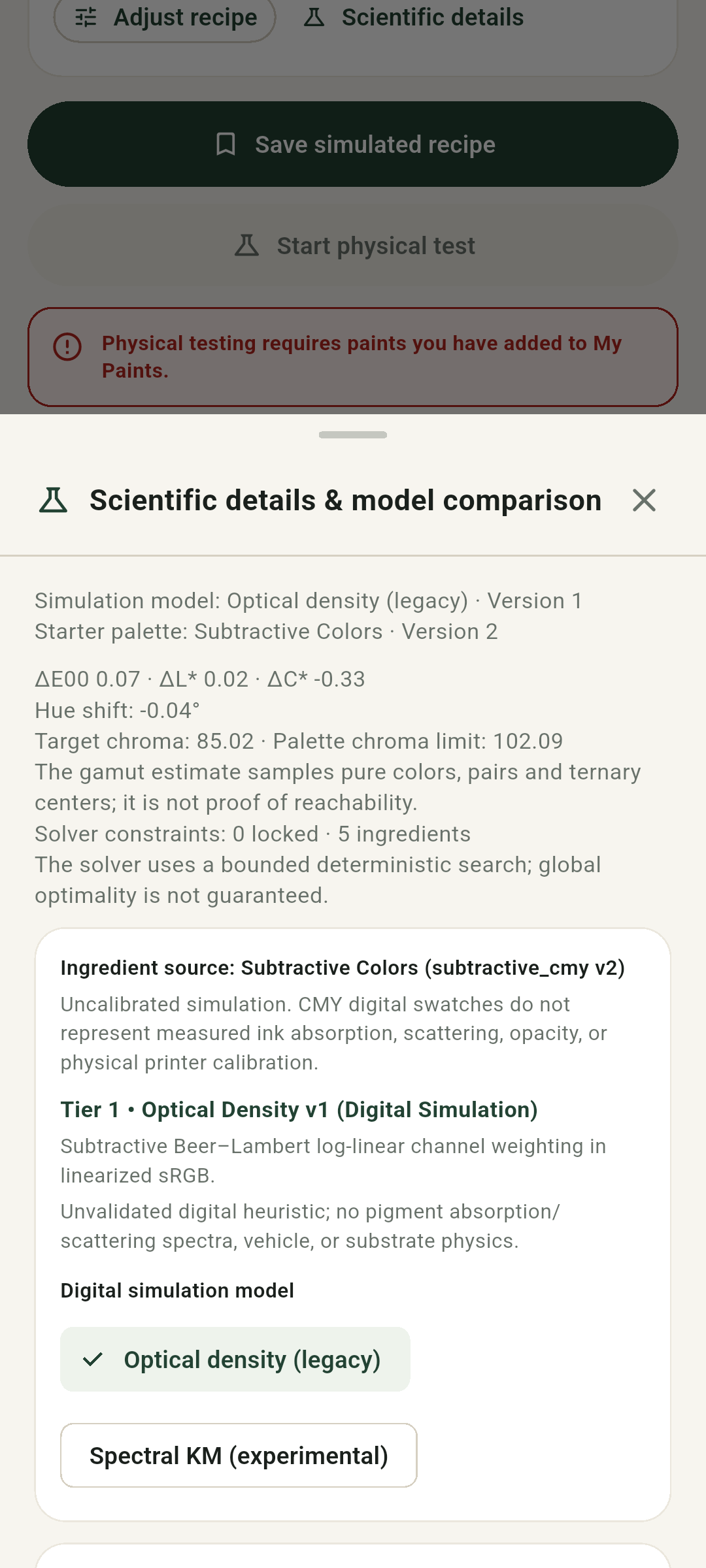
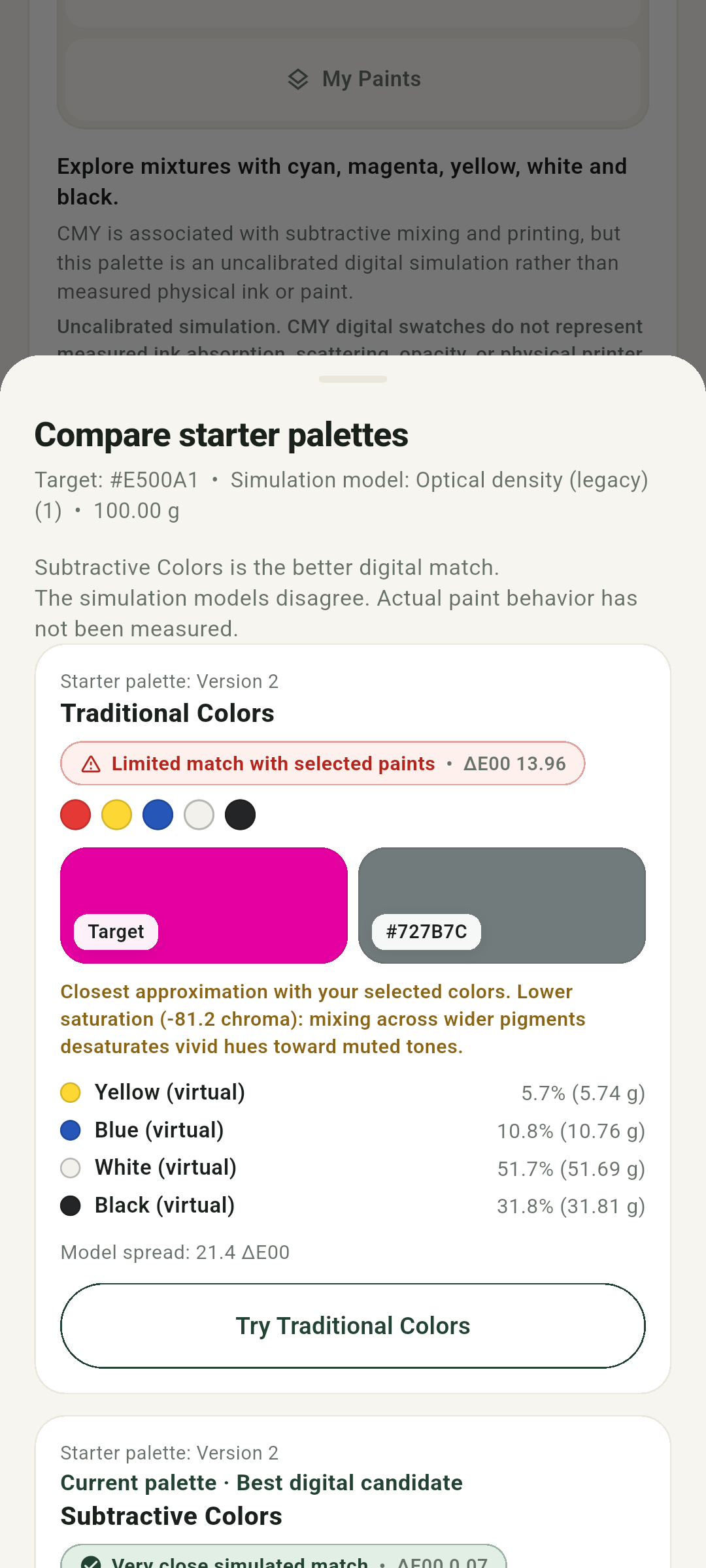
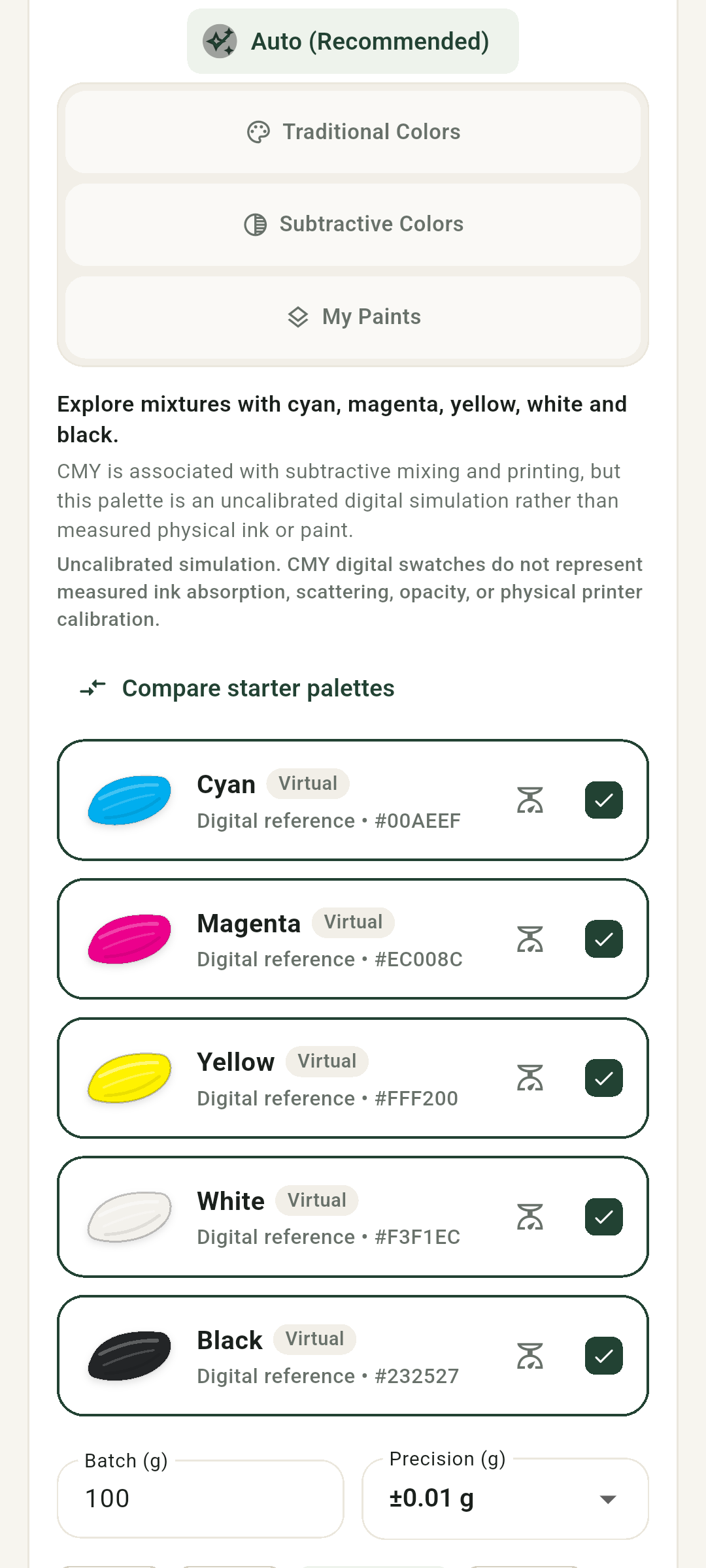
Production interface in action.
Real production screenshots captured on physical Android and iOS devices, illustrating real-time color formulation, spectral analysis, and palette management.
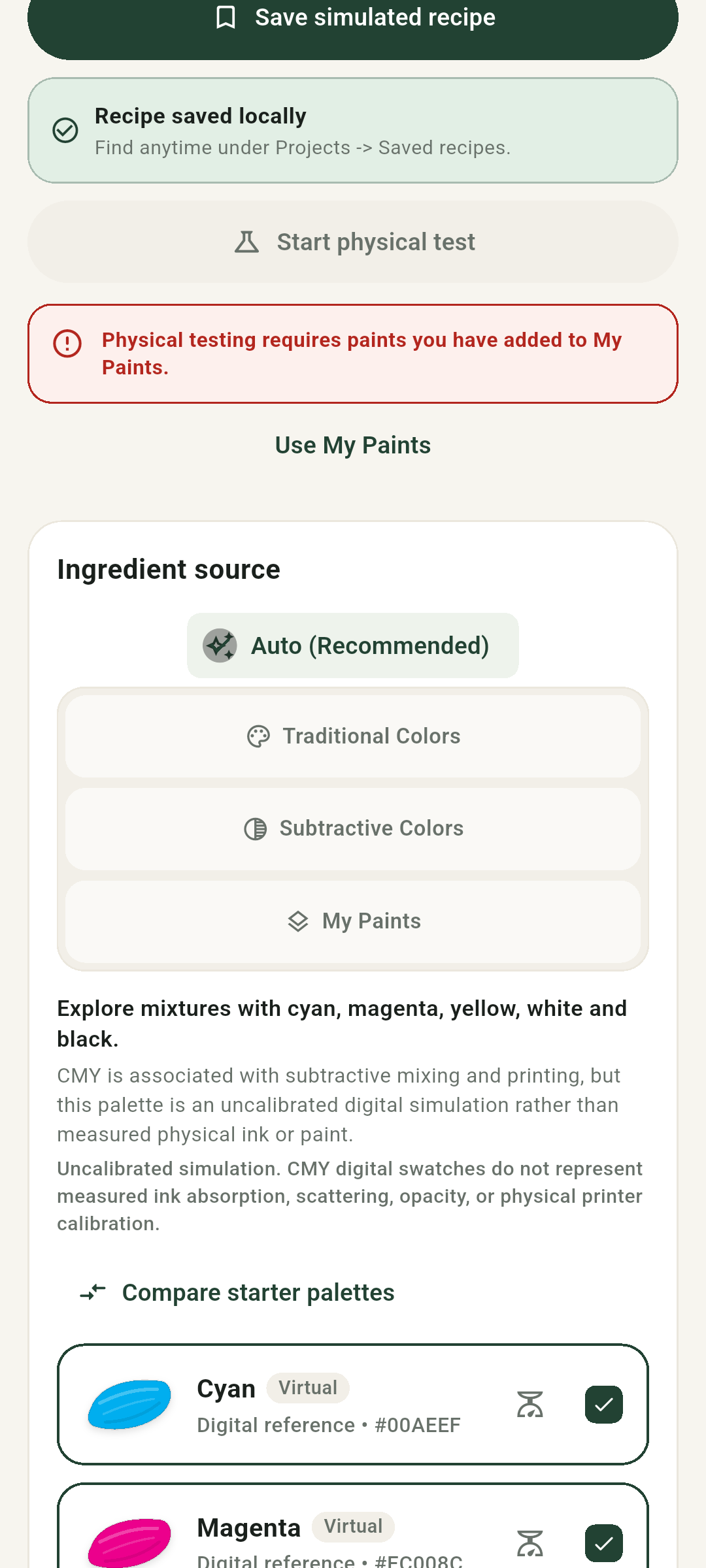
Studio-grade interface, adapted for dark and light rooms.
Whether painting in a daylight studio or working on miniatures under a focused desk lamp at night, Paint Match & Mix adapts with laboratory-grade ergonomics, high-contrast dark mode, and seamless multi-language localization.
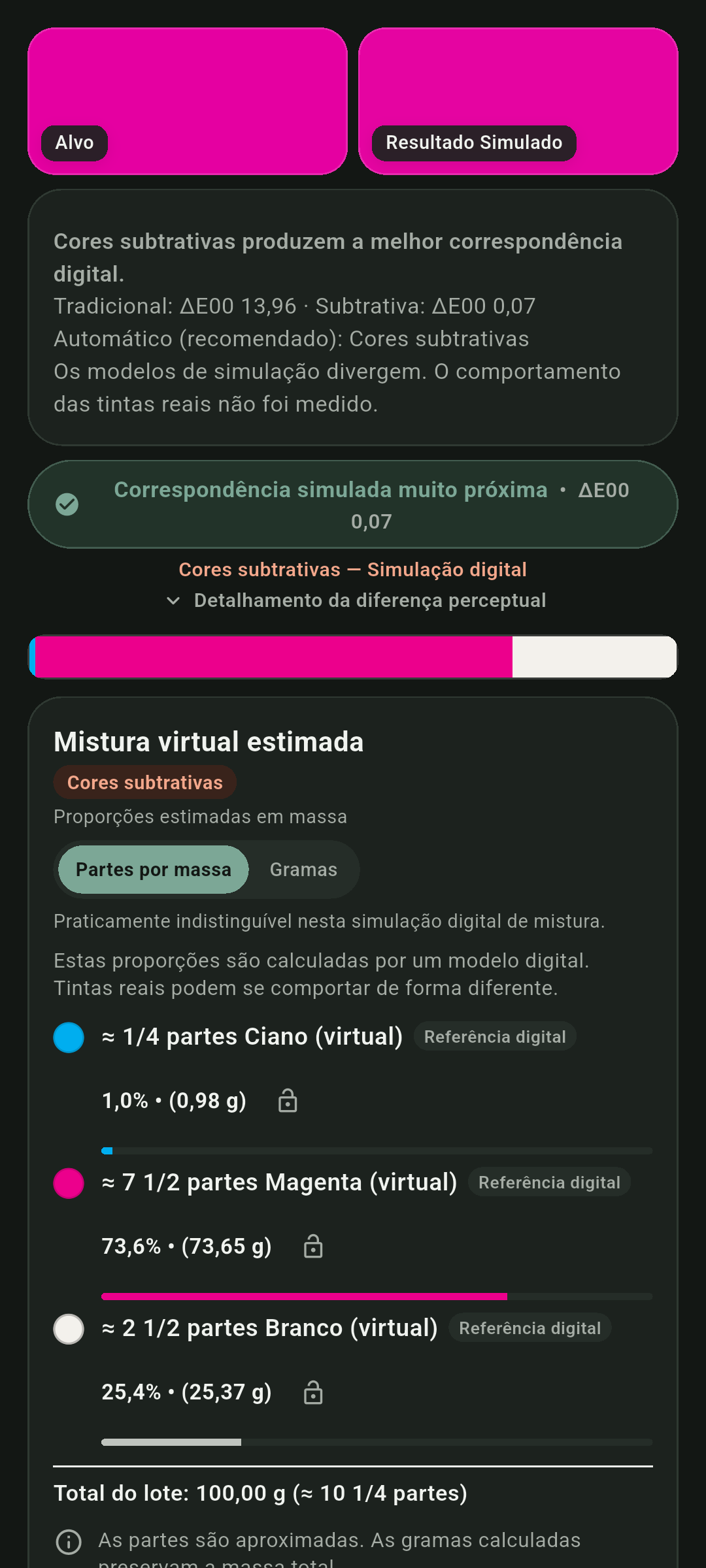

Engineered for mathematical integrity.
An inside look at the software architecture that turns raw camera pixels into mathematically validated physical pigment formulas.
Kubelka-Munk Subtractive Physics
Light entering a physical paint film undergoes continuous absorption and scattering. Paint Match & Mix models this using Saunders-Lovett extended Kubelka-Munk equations:(K/S)_mix = Σ c_i (K_i / S_i). Reflectance curves are converted into CIE XYZ tristimulus values under standard D65 illuminants (2° standard observer) and transformed into perceptually uniform CIE L*a*b* color space.
Real-Time Computer Vision & Loupe
Camera frames are streamed through a high-performance image processing isolate. Real-time circular loupe magnification isolates micro-regions to eliminate surface specular glare and shadows. Chromatic aberration and sensor noise are smoothed using multi-frame spatial temporal filtering entirely in volatile memory.
Offline-First Isolation with Drift
Persistence is powered by an offline Drift SQLite database migrated to v7. Studio profiles, recipes, paint inventory, and experiment snapshots are strictly isolated by local profile ID. Cross-account data leaks are impossible by architectural design, and the entire app runs indefinitely with airplane mode enabled.
Biometric App Lock & Secure Enclave
To protect sensitive studio formulas and client projects on shared devices, an optional Biometric App Lock binds directly to the device's Secure Enclave (LocalAuthentication on iOS / BiometricPrompt on Android). Studio screens are automatically obscured in the operating system task switcher.
Spectral Matching Verification Benchmarks
- Burnt Sienna (L* 64.2, a* 28.5, b* 41.2)
- Ultramarine Shadow (L* 28.1, a* 12.4, b* -38.6)
- Viridian Deep (L* 42.6, a* -36.2, b* 14.8)
- Cadmium Yellow Tint (L* 88.4, a* -2.1, b* 78.4)
- Alizarin Crimson (L* 38.4, a* 46.2, b* 18.5)
- Raw Umber Wash (L* 48.2, a* 8.1, b* 22.4)
- White 42% • Red 31% • Yellow 21% • Blue 6%
- Ultramarine 78% • Black 14% • White 8%
- Phthalo Green 62% • Yellow 26% • White 12%
- White 74% • Hansa Yellow 24% • Red 2%
- Magenta 68% • Cadmium Red 24% • Black 8%
- Yellow Ochre 45% • Black 32% • Red 23%
- ΔE = 0.84 (Imperceptible to human eye)
- ΔE = 0.62 (Laboratory exact match)
- ΔE = 0.91 (Imperceptible difference)
- ΔE = 0.73 (Near-perfect match)
- ΔE = 0.88 (Sub-perceptual match)
- ΔE = 0.69 (Exact pigment match)